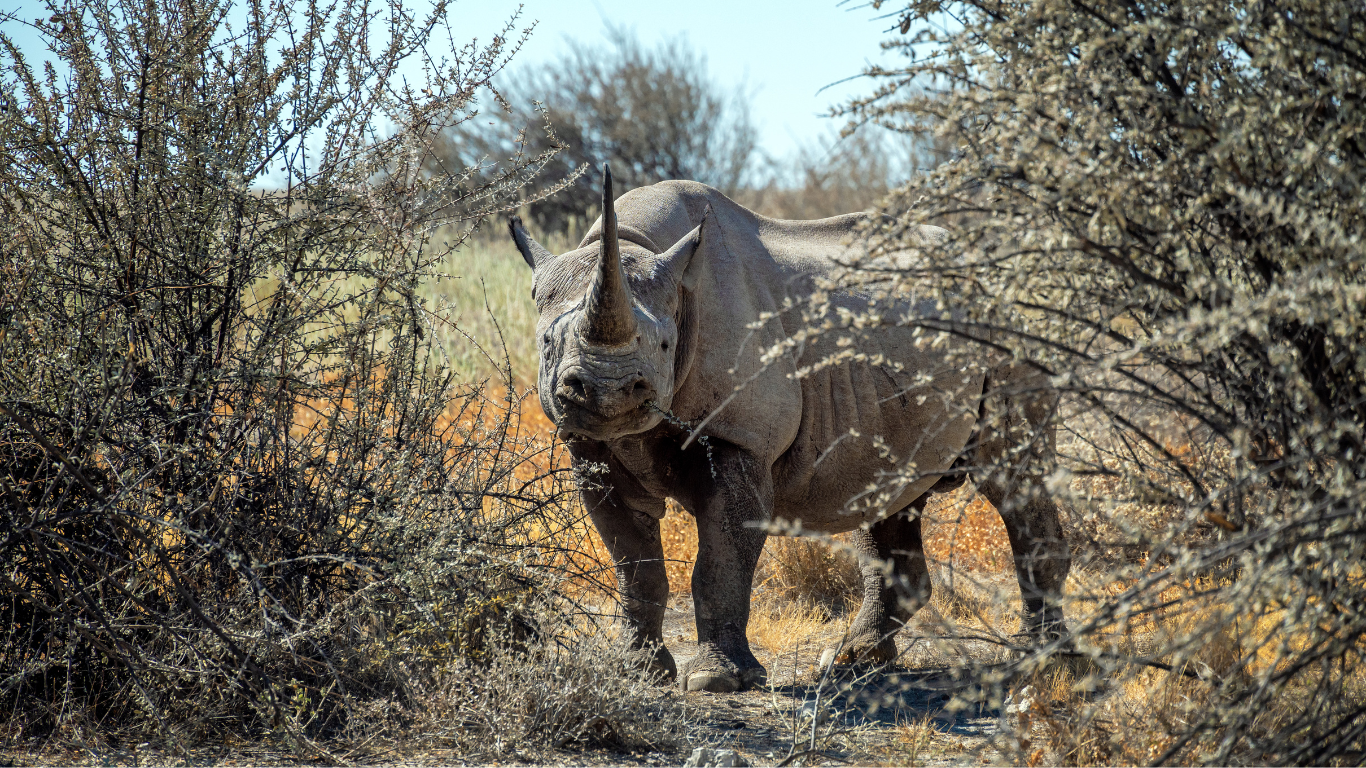
Rhinoceroses, one of the largest groups of animals on the planet, are fighting a battle for survival because of a prized body part: their horn, which they use to defend territories, assert dominance and protect their young.
But people use this keratinous horn as medicine, adornment and decoration. In traditional Chinese medicine, it’s believed to have broad healing properties. The horns are also crafted into jewelry, and carved horns are displayed as luxury items.
The unrelenting demand for their horns has decimated these mega-herbivores across their Asian and African ranges, and combating the trade is a tough fight: Rhino horns are extremely valuable. They’re worth an estimated $20,000 per kilogram (about $9,090 per pound) on the black market, often trafficked and sold by transnational organized crime syndicates.
Poaching has pushed three of the five living rhino species to the brink. The International Rhino Foundation estimates that some 500,000 roamed the wild at the start of the 20th century; today, just under 27,000 remain, and a rhino is killed every 15 hours.
China is the largest consumer, but data on trade within its borders is limited. A team from the U.S.-based Environmental Investigation Agency (EIA) tried to bridge the information gap in a new report.
It analyzed 258 court cases involving horn trafficking between 2013 and October 2025, posted on the China Judgments Online database. These court records revealed that authorities seized 700 kilograms (1,543 pounds) of rhino horns during that period, which means that perhaps 200 rhinos were killed to supply this market during that period.
There were 512 arrests. Those smugglers faced prison sentences averaging 4.5 years and paid fines of about 92,322 yuan ($13,540). Most of these crimes involved less than 10 kg (22 lb) of rhino horn.
China’s long-drawn appetite for rhino horns Demand for rhino horn grew alongside rising wealth in China and Southeast Asia in the 1980s and ’90s, and poachers decimated all five species of these mega-herbivores in Asia and Africa. Three are now critically endangered: the black rhino (Diceros bicornis ), the Javan rhino (Rhinoceros sondaicus ) and the Sumatran rhino (Dicerorhinus sumatrensis ). Amid poaching and ever-shrinking habitat, Africa’s white rhino (Ceratotherium simum ), the most populous and least threatened species, has dwindled to a two-decade low, according to the most recent IUCN-TRAFFIC assessment. The greater one-horned rhino (Rhinoceros unicornis ) is threatened.
Poaching and trafficking of rhino horns continue despite a ban on international trade in 1977 under CITES, a global wildlife trade treaty. In China, domestic trade was legal until 1993, when it was outlawed.
But then, 25 years later, the Chinese ban was partially lifted. In 2018, the government permitted the use of powdered horns from farmed rhinos in “qualified hospitals by qualified doctors recognized by the State Administration of Traditional Chinese Medicine” and also as “cultural relics.”
For decades, researchers monitoring the international rhino horn trade have been aware that China is the largest consumer, based on seizures, which are often a sliver of the actual trade. But information on the volume of trade within its borders is limited.
“We know that China is one of the primary end-use countries for rhino horn,” said Taylor Tench, senior wildlife policy analyst at EIA and the lead of its rhino campaign.
But so far, there’s patchy data on the extent of the domestic trade in China and the country’s response to it through its judicial system. China hasn’t fully reported either its horn stockpiles or its seizure data to CITES, making it challenging to understand the trade within its borders, Tench said.
China Judgements Online, an online database with more than 143 million court cases resulting in criminal charges, is not an exhaustive source. It doesn’t include cases that weren’t prosecuted in courts, and importantly, it omits data from both Hong Kong, an extremely active wildlife trade hub, and Macau.
Susan Lieberman, vice president of international policy at the nonprofit Wildlife Conservation Society, said this new report provides “useful insight into the trafficking” in China. “Analysis of court cases can assist in understanding trafficking routes and patterns and the outcomes of criminal cases. It is, however, the ‘tip of the iceberg,’ and is dependent on enforcement efforts and the nature of cases that actually go to court,” she said in an email.
Trends in the Chinese rhino horn trade EIA’s investigation indicates there are many Southeast Asia-based traders who still offer rhino horns to Chinese consumers for medicinal purposes. While this creates a huge demand, the horn is hard to detect in its powdered form, which may be one confounding factor in their finding that most seizures were either rhino horns worked into carvings or pieces made into jewelry.
“The seizures involved either antique and curio stores or physical market stalls,” Tench said, some of which also sold small quantities of rhino horns. “Taken together, cumulatively, it’s a potentially significant force contributing to the illegal trade within China, and it warrants much more research into the sourcing of [the horns] and distribution.”
Rhino horn seizures peaked in 2020, surging from just two in 2013 to 72 seven years later, but have dropped steeply to fewer than 10 since 2022.
Tench cited a few reasons that could explain why, which raise questions about the true volume of China’s domestic trade.
With the onset of the COVID-19 pandemic, international travel essentially stopped, with borders shut down. The movement of people and goods, including contraband, slowed dramatically. Meanwhile, law enforcement and reporting were weak.
And in 2020, Chinese authorities began removing “sensitive” judgments from the database of court cases, which likely impacted accounting on wildlife crime. So lower seizure numbers may not necessarily mean that trafficking has declined.
About 72% of the 258 cases analyzed by EIA included products from other endangered wildlife: elephant ivory or skin, helmeted hornbill (Rhinoplax vigil ) casques, pangolin scales, golden coin turtles (Cuora trifasciata ) and Przewalski’s gazelle (Procapra przewalskii ) horns.
“I was a bit surprised by the wide diversity of other illegal wildlife products trafficking along with rhino horn, but I shouldn’t be surprised. Criminals will do what they can to meet the demand of buyers,” Lieberman said.
Trafficking routes into China Court cases showed that rhino horns move across China through a complex network of international and domestic routes connecting Africa, Southeast Asia and major Chinese markets.
All of the horns seized by authorities came from Africa. White rhinos accounted for more than three-fourths of these cases; 21% of seizures came from critically endangered black rhinos, of which just 6,788 remain in the wild.
South Africa and Mozambique were the main African source and transit countries. In Asia, Hong Kong was a key transit hub for more than half of all cases through which the horns came to China.
“South Africa is still very much in the thick of a poaching crisis, and then we continue to see the trafficking,” Tench said.
Meanwhile, attempts are underway there to legalize the horn trade from private rhino owners. Though some argue it could decrease smuggling and poaching, wildlife trade experts oppose it.
“Allowing legal commercial trade in horn from some rhinos would increase demand and poaching pressure on all rhino populations,” Tench said. If legalized, he added that traffickers will make a profit by “obtaining rhino horn through illicit means, including, of course, poaching.”
With organized crime syndicates running this lucrative trade, it’s an ongoing fight for law enforcement. Wildlife trafficking is usually a low-risk crime: Few smugglers are caught, usually the poachers or mules, who are easily replaced, and relatively low fines are just part of the cost of doing business. The cartel kingpins masterminding this illegal commerce and profiting from it are rarely apprehended.
At the most recent meeting of CITES delegates in November 2025, Namibia attempted to reopen international trade in stockpiled white and black rhino horns. The proposal was rejected, but discussions are ongoing in other Southern African countries to sell off stockpiles, purportedly to raise money for conservation.
But experts warn that this is a dangerous move. A similar attempt permitting the sale of elephant ivory in 2008 had deadly consequences.
CITES allowed a one-time sell-off of 108 metric tons of stockpiled ivory to China and Japan from four African countries: Botswana, Namibia, South Africa and Zimbabwe. Instead of flooding the market and reducing prices as intended, it increased demand and triggered widespread poaching. Over the next eight years, the illegal ivory trade increased by 66% and seizures by 71%. It’s believed that about 100,000 elephants were killed from 2011 to 2014 to meet demand.
If stockpiles were put on the market, “it is certain that demand would increase — that always happens when previously prohibited wildlife products are allowed to be traded,” Lieberman said. “There are consumers who know it is illegal and don’t buy it, but if it were legalized, they would enter the market, putting increased pressure on wild populations and causing increased poaching.”
With any legal trade of an in-demand protected species, there’s some degree of laundering as well as sales to traffickers, and experts say horns from newly killed rhinos would be intermixed with stockpile sales.
“We know that rhino horn leaks from stockpiles onto the illegal market through thefts,” Tench said, adding that those who own these horns intentionally sell them to traffickers.
He cited a recent case in South Africa where former rhino breeder, John Hume, and five others were arrested for allegedly trafficking 960 horns out of the country. They’d used a loophole allowing domestic trade to pull the horns from Hume’s vaults and then sold them internationally.
EIA found that horns enter China primarily through two routes: direct imports from southern Africa into the country or they are smuggled overland from neighboring countries through transporters, such as taxi drivers or couriers.
The study fund that Southern Chinese provinces were hotspots of trafficking, specifically Guangxi and Yunnan, which border Myanmar, Vietnam and Laos. About a third of consumers were in big cities: Beijing, Jiangsu and Shanghai.
“From 2013 to 2019, we saw rhino horns being shipped from Africa to China via air, and the end destination was Chinese airports,” Tench said. That trend changed in 2019 after China upped enforcement at ports of entry. Then, he said, “The horn was being moved to Southeast Asia and being smuggled into China over the southern border in its southern provinces, which is what we’re still seeing today.”
Rhino horn pieces, such as these seized by the Hong Kong Customs officials in 2018, are easy to conceal and smuggle, compared to full-sized horns. Image courtesy of the Hong Kong Customs and Excise Department. Collaboration can disrupt trade Data on trends and smuggling routes enable authorities to act. EIA’s study suggests that China should prioritize intelligence-led law enforcement and anti-corruption activities in provinces and towns along the southern border smuggling hotspots. Experts say the report highlights the importance of collaboration and information-sharing with both source and neighboring countries.
It’s also critical for China to share samples of seized horn with the Rhino DNA Indexing System (RhODIS), an online forensic database, so investigators can identify where the horns came from, the report says.
“The message to any country implicated in the illegal rhino horn trade is the need for improved and consistent information sharing with other impacted countries. … That’s something we’re still not seeing to the level that is necessary to effectively disrupt this trade,” Tench said.
There have been some inroads. “The recent arrest of alleged Vietnamese rhino horn trafficker Chu Dang Khoa in South Africa and members of his network seems to be very promising,” Tench said. Khoa purportedly ran a rhino horn and tiger bone trafficking syndicate that staged an armed robbery of 98 horns from Voi Game Lodge, his private game reserve, which he then trafficked to Asia.
Lieberman said increasing enforcement efforts and imposing stricter penalties for poachers could limit illicit trade. “I appreciate that China is making seizures of rhino horn, and [prosecuting] cases, including imposing custodial sentences,” she said. But ultimately, “These cases show that much more needs to be done to protect rhinos.”