Decades after its release into the wild, a super-ageing, bone-crunching vulture called Balthazar reveals a major conservation success. In the autumn of 2025, wildlife experts in the French Alps made a surprising discovery: a frail, weakened bearded vulture found lying on the ground turned out to be Balthazar, a bird released under a conservation programme in 1988, who had vanished from observations. Having been presumed dead, at over 37 years old, he is in fact the oldest bearded vulture ever to have been recorded in the wild.
Over his long life, Balthazar witnessed the return of his own species to Alpine skies and cliffs, as bearded vultures have soared back from local extinction.
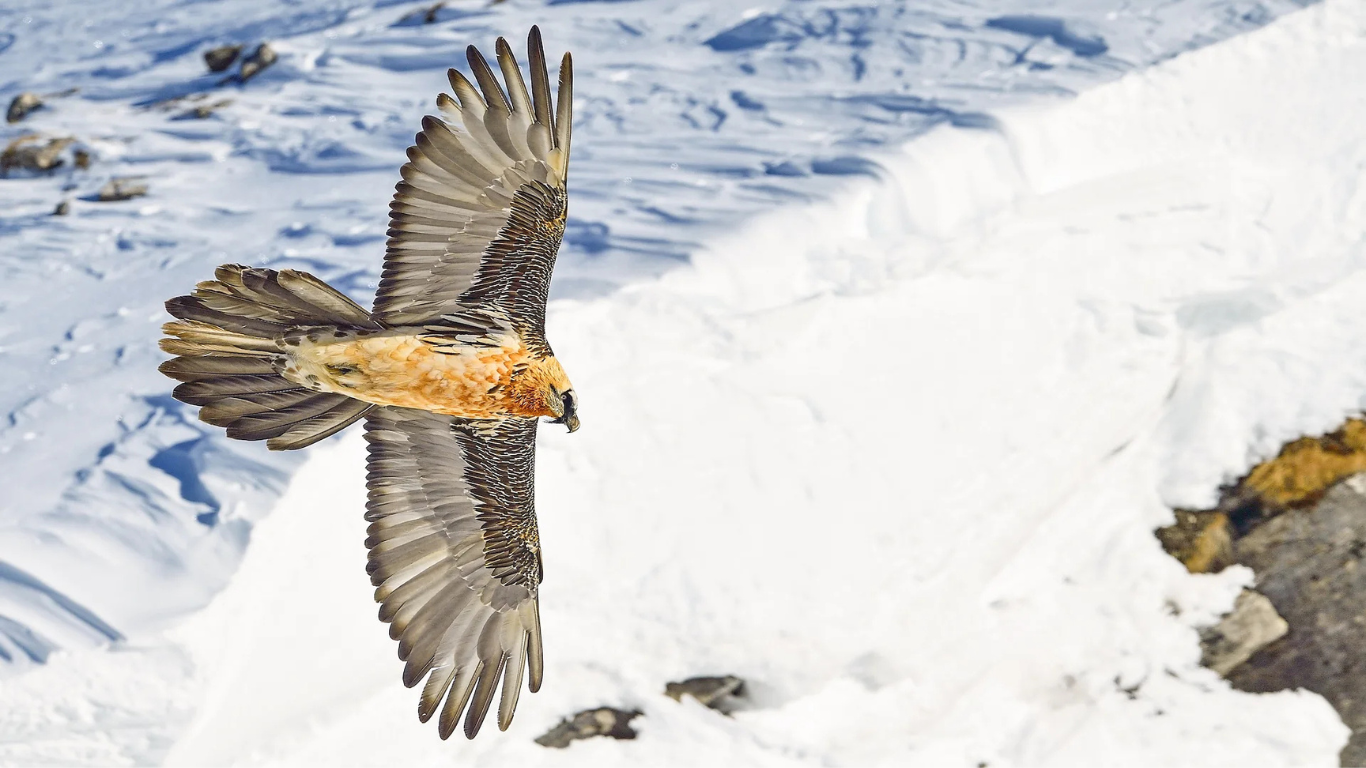
Bearded vultures are majestic, cliff-nesting birds with wing spans of 2.5m (8.2ft) or more, about the size of a flying door. Their diet is one of their many intriguing features: they are thought to be the only animal that is ossivorous, meaning, they feed mainly on bones.
The Spanish name for bearded vulture, quebrantahuesos (bone-breaker), in fact hints at the complex acrobatics this diet involves. The birds scavenge bones from carcasses, then drop them onto rocks from a great height to smash them into smaller pieces. They often have favourite bone-breaking sites, known as ossuaries, close to their nests.
These bone-smashing birds used to roam the mountains of southern Europe but were hunted into extinction in the Alps and were last seen there in the early 1900s, surviving only as tiny wild populations in some other areas of Europe. Beginning in 1986, however, and over a number of decades, conservationists released a total of over 260 bearded vultures bred in captivity into the Alpine regions of Austria, Italy, Switzerland, France and Germany.
Bearded vultures raise their chicks high up in the Alps' snowy cliffs. Credit: weyrichfoto/ VCF
Balthazar was among those early releases in the 1980s, and fathered the first chick raised in the wild in the Alps, after the species had been absent for decades. Today, bearded vultures are successfully breeding and raising chicks in the wild again. In 2025, the wild population of bearded vultures in the Alps passed 100 breeding pairs for the first time, to a total of 118. The population is self-sustaining (you can follow some of their awe-inspiring tracked journeys across wild valleys, ridges and rivers on these maps).
"It's a very successful story, a very beautiful story," says José Tavares, the director of the Vulture Conservation Foundation, one of the main organisations behind the reintroduction programme. "It's a huge success, demonstrating that when there is will and a little bit of funding and a little bit of political support, we can actually reverse the loss of biodiversity and achieve fantastic results," Tavares says.
Humans and bearded vultures have an extraordinarily long shared history in Europe. A study of ancient vulture nests in cliff caves in southern Spain, which had been re-used by the birds for generations, found an astonishing range of historical artefacts in them, including a 13th-Century sandal. But that co-existence has also been marked by persecution.
"In the late 19th, early 20th Centuries, there was rampant persecution of bearded vultures in the Alps," says Tavares. He points out that an old German name for the vultures is Lämmergeier , "lamb-vulture", as they were mistakenly believed to hunt lambs (they are now known as Bartgeier , "bearded vulture", in German). In reality, vultures actually play a crucial role in keeping ecosystems healthy, by devouring dead animals and preventing the spread of disease.
Anti-vulture cultural beliefs even gave rise to the plot of a famous 19th-Century Swiss novel, Geier-Wally ("Vulture-Wally"), about a girl who is told to climb into a vulture's nest and kill the chick in it but instead, saves and raises it.
Conservationists released Balthazar, a vulture, in the Alps in the 1980s. Decades later, he is still alive. Credit: ASTERS
"[The 19th Century] was a very dark time for wildlife in general and large carnivores and raptors in particular. There were bounties for hunters bringing back [the carcass] of a bearded vulture," explains Julien Terraube, a senior researcher at the French Biodiversity Agency, who has co-authored a 2025 assessment of the bearded vulture reintroduction programme in the Alps. The study finds that both the number of birds and their breeding success – meaning, their ability to raise chicks in the wild, as measured by what proportion of nests with eggs lead to a fledgling – have increased over time throughout the Alpine region, showing that the reintroduction programme has been successful.
In addition to the reintroduction programme, a number of factors have helped the bearded vultures come back to the Alps, even as their status across Europe remains threatened.
Perhaps most importantly, bearded vultures are now a protected species in Europe and hunting them is banned (though there have been some illegal killings). As other species such as ibex and chamois have rebounded, thanks to wider conservation measures, there is more food for the vultures to scavenge. Protected areas in the Alps, which can be less disturbed by humans and more abundant in wildlife than other areas, have also helped the vultures' breeding success.
There are also individual factors. Vultures can live very long lives – 37 years and counting, in Balthazar's case. Over that lifespan, they gain experience, which is especially important when it comes to parenting. Bearded vultures start breeding when they are about eight years old and continue to reproduce into their 20s or even 30s, giving them plenty of time to learn and improve.
As a result, when it comes to raising their chicks to adulthood, "older birds are better than younger ones because they have acquired more experience," says Terraube, based on his team's analysis. "The longer the breeding pair has been together, the better they were as parents, and the higher their breeding success," he explains.
Bearded vultures were once reviled, but they are an important part of the Alpine ecosystem. Credit: weyrichfoto / VCF
That's because raising chicks in the high mountains, at 2,000m (6,562ft) above sea level, requires many skills, he says: where to build a sheltered, safe nest in high cliffs, in a space that's protected from rain and snow; where to find food for the growing chick; and how to defend it against predators such as ravens. Given that the chicks hatch around March and don't fly from the nest until July or August, the nest needs to serve them for a very long time, Terraube adds.
To feed the female vulture while she incubates the egg, the male vulture also has to know where to find bones, which he then flings against rocks to break them and pick out the marrow. Again, this knowledge and skill improves with experience, Terraube says: "All those factors help explain the fact that older parents are better than younger ones".
Parenting also played an intriguing role in other parts of the programme. For example, the conservationists used artificial incubation and egg adoption to make the most of the eggs laid by the captive birds, and grow a population big enough to replenish the wild community.
In the wild, bearded vultures lay two eggs in the winter months, but end up raising only one chick, Tavares from the Vulture Conservation Foundation explains. That's because in the days after the chicks hatch, the stronger one kills the weaker one, a strategy known as evolutionary cainism. It is thought to have evolved to give the surviving chick the best chance of making it through the harsh Alpine winter and spring.
In captivity, the vulture pairs also lay two eggs. But to save the second chick, the conservationists then take one of the eggs, hatch it in an incubator, and slip the chick into the nest of a pair that has accidentally smashed its own egg, or whose chick has died. The pair then usually adopts and raises the chick.
Experts warn that bearded vultures still face threats such as illegal killings. Credit: Andrea de Giovanni
Banner credit: weyrichfoto / VCF