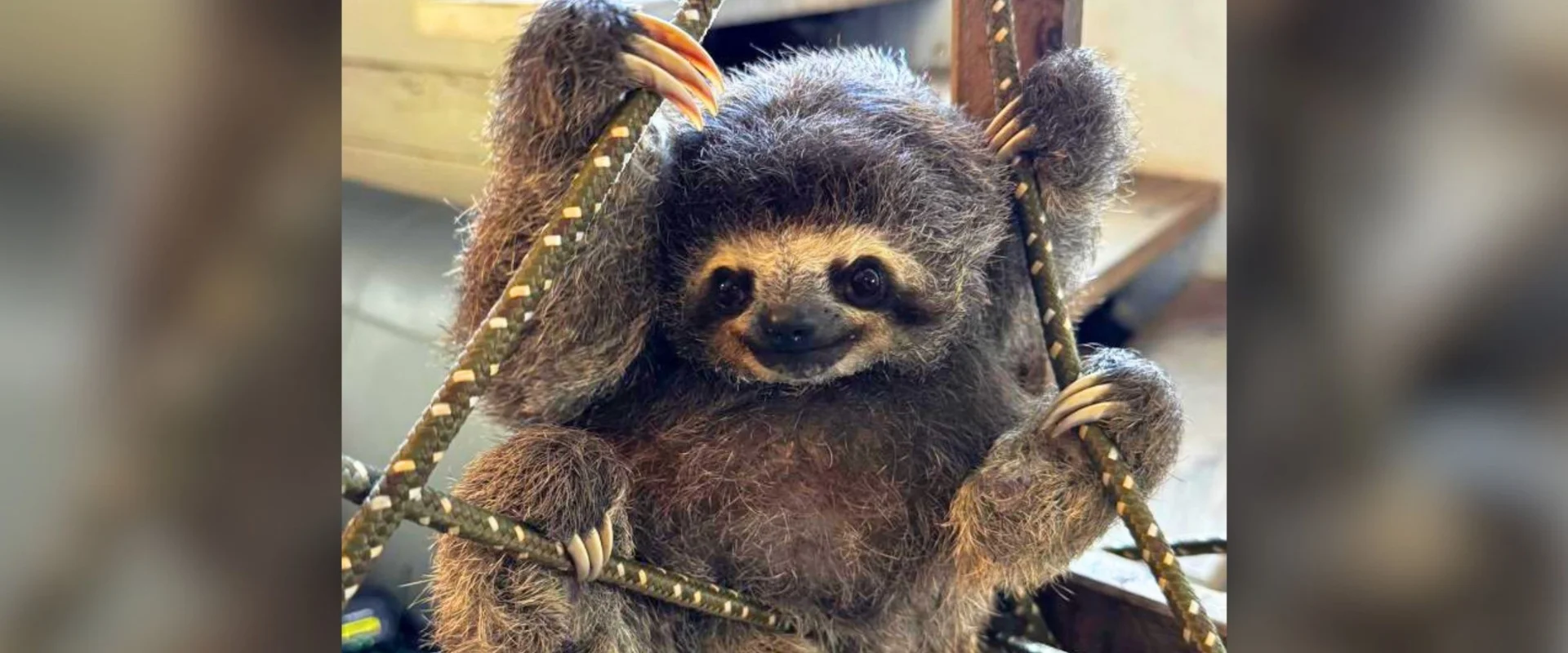


A few days ago, I wrote to you about Baby, the orphaned sloth in Venezuela whose mother was killed by stray dogs.
I am writing again because we have not yet raised enough funds to give her rescuers the equipment they need.
Baby is safe and growing stronger. But the danger facing Venezuela’s sloths has not changed. Her rescuers are still responding to sloths stranded on power lines without all the insulated equipment they need to reach them safely. The next call will come – whether the team is properly equipped or not.
I am asking again: please consider making a gift today. Baby’s rescuers have almost no funding and every contribution will help them continue their vital work.
Baby was only days old when stray dogs killed her mother near Caracas.
She was entirely dependent on her. Everything a young sloth needs – milk, warmth and the long apprenticeship that teaches her which leaves to eat and which branches will hold her weight – Baby should have learned from a mother who was no longer there.
Sloths are tree-dwelling mammals found in the forests of Central and South America. They are roughly the size of a large house cat, with long, curved claws that work like hooks and an extraordinarily slow digestive system that can take weeks to process a meal of leaves.
Baby is a brown-throated three-toed sloth. She belongs in the forest canopy. For now, she is being hand-reared in the home of the people determined to return her there.
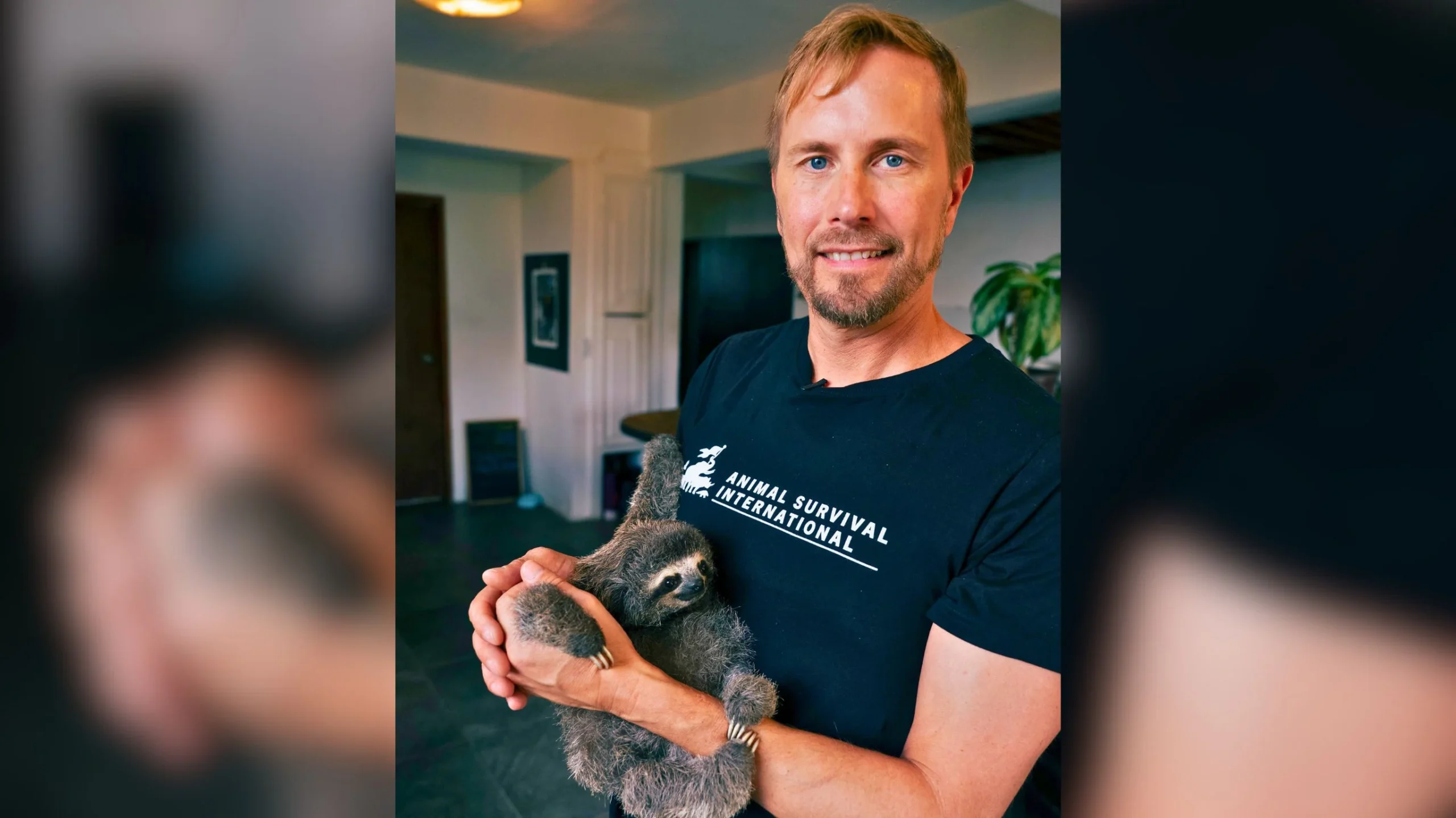 Baby is doing well. She now weighs almost a kilogram, nearly four times what she weighed when she arrived at Fundación Chuwie. At two kilograms, the next stage of her rehabilitation will begin. Source: ASI/Dan Snyders
When I met her, her grip explained everything.
At our partner, Fundación Chuwie, Baby was placed briefly against me under her rescuers’ supervision. She took hold of my clothing immediately, and her grip was astonishing.
It felt like an embrace. It was nothing of the kind.
An infant sloth grips because, in the forest, letting go means falling from the trees. Baby was following the instinct that should have kept her attached to her mother.
Built for a forest that is coming apart.
Sloths are superbly adapted to the forest canopy. They move slowly enough not to register as movement, and algae grows in their fur, tinting them green until they disappear into the leaves. A predator can look directly at a sloth and fail to see an animal at all.
When development breaks that canopy into fragments, every one of those adaptations turns against them.
A sloth on the ground cannot outrun a dog or escape a car. And where branches have been replaced by cable, it will reach for a power line exactly as it would reach for a vine – then hold on, because holding on is the only thing it knows how to do.
One rescued sloth started a project that now helps 300 every year.
Juan Carlos and Haydée Rodríguez found a sloth grievously injured on a high-voltage line. They had no training. They called specialists in Costa Rica and Panama, did as they were told, and the animal lived. They named him Chuwie, and his face is now the logo of the foundation his rescue created.
They care for sloths in their own home, because the animals keep arriving – around 300 a year, attacked by dogs, struck by cars or stranded on power lines. They have never turned one away.
If a sloth finds its way onto a power line, getting it down safely is specialist work. A frightened animal grips with enormous force, and pulling it free will be terribly painful. Rescuers use insulated tools to reach it, cut it free and lower it without anyone touching a live line.
 The power lines around Caracas have become death traps for sloths. Specialized equipment like insulated poles and hot-stick tools are needed for emergency rescues. Source: Fundación Chuwie
Everything depends on that equipment being in the vehicle before the call comes.
Animal Survival International is raising $6,400 (£4,800) to equip Venezuela’s only sloth rescue team properly – insulated poles and hot-stick tools, a pole saw, a ladder, gloves, nets, transport crates, recovery enclosures, first-response supplies, orphan formula and fuel.
Here is exactly what your gift buys:
- $25 (£19) – formula and supplements for an orphan like Baby
- $100 (£75) – gloves, nets and a transport crate: what it takes to carry one sloth safely
- $350 (£265) – a recovery enclosure, so an injured sloth heals properly
- $900 (£680) – the insulated rescue poles. The difference between one casualty and two.
Baby is doing well. Most sloths are not.
Baby now weighs almost a kilogram – nearly four times what she weighed when she arrived. At two kilograms, the next stage of her rehabilitation begins, and if she keeps going as she is, she may one day go back into the forest wearing a tracking device.
But any donation you give is not only about Baby.
The equipment will still be there for the next sloth, and the one after that. It cannot put a forest back together. It decides whether a rescuer reaches an animal safely, whether an injured sloth is carried without being hurt further, and whether the next orphan is fed.
Baby survived because trained people were ready. Please help us keep them ready.